McIlroy's Turbulent Start at 2026 US PGA Championship
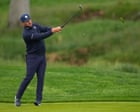
Opening Round Challenges at the 2026 US PGA Championship
The first day of the 2026 US PGA Championship at Aronimink Golf Club in Pennsylvania kicked off with high expectations, but for some top contenders, it quickly turned into a test of resilience. Rory McIlroy, the Northern Irish golfing star known for his powerful drives and consistent performance, found himself in an unexpected predicament right from the start. On the par-4 first hole, McIlroy's tee shot struck a tree on the right side of the fairway, sending the ball plummeting into dense rough. Attempting to recover, he swung with considerable force, but the ball merely topped and trickled just 100 yards down the fairway. This mishap underscored the unpredictable nature of Aronimink's challenging layout, where precision off the tee is crucial despite McIlroy's pre-tournament assertion that strategy in that area was minimal.
McIlroy's early struggle highlighted the mental and physical demands of major championships. Having entered the event as one of the favorites, his performance on the opening holes served as a reminder that even elite players can face setbacks. The incident on the first hole forced McIlroy to scramble for par, potentially affecting his rhythm for the rest of the round. Observers noted that this was not just a physical error but also a strategic one, as the rough at Aronimink is notoriously thick, punishing any deviation from the fairway. This early blemish could have implications for McIlroy's overall standing, especially in a field packed with competitors eager to capitalize on any mistakes.
Meanwhile, Bryson DeChambeau, the two-time US Open champion renowned for his analytical approach to the game, also experienced an uneven beginning. On the 10th hole, DeChambeau's approach shot fell short, setting a tone of uncertainty. Transitioning to the 11th, he overhit his wedge, sending the ball past the green and into the fringe. DeChambeau, who often relies on precise distance control derived from his physics background, paused to consult his caddie, asking if the shot was short. This moment of doubt illustrated the fine margins at play in a major like the PGA Championship, where even minor miscalculations can compound. Despite managing to salvage a par with a couple of putts, his start raised questions about whether he had fully adapted to the course's nuances on this day.
Context and Implications for the Tournament
The 2026 US PGA Championship, held at Aronimink Golf Club, represents a return to a classic venue that demands both power and accuracy from players. Aronimink, with its tree-lined fairways and undulating greens, has a history of producing dramatic outcomes, as seen in past events. For McIlroy, this early stumble might echo his previous major challenges, where maintaining consistency over four rounds has been key to success. His pre-tournament comments about minimal tee strategy were quickly contradicted by the reality on the course, emphasizing how conditions can evolve and force adjustments. In the broader context of 2026 golf, with emerging talents and seasoned veterans vying for supremacy, such moments could shift momentum in a tightly contested field.
DeChambeau's uncertain start, on the other hand, adds another layer to the narrative of player adaptation. Known for his methodical preparation, including custom club fittings and swing analytics, DeChambeau's overhit wedge suggests that even the most data-driven approaches can falter under pressure. This could prompt him to recalibrate his game plan for subsequent rounds, focusing on finer distance control to avoid similar issues. The implications extend beyond individual performances; these early exchanges might influence leaderboard dynamics, potentially opening doors for underdogs or other top players like Scottie Scheffler or Xander Schauffele, who were not detailed in initial updates but are expected to perform strongly.
As the day progressed, the official leaderboard reflected a mix of scores, with players navigating Aronimink's hazards under partly cloudy skies and moderate winds. The course, measuring over 7,000 yards with a par of 70, rewards those who can balance aggression with caution. For McIlroy and DeChambeau, recovering from their opening holes will be essential to mounting a challenge over the weekend. Golf analysts are already speculating on how these incidents might affect their mental game, given the tournament's status as a major that often defines careers.
A Look at the Bigger Picture
In the evolving landscape of professional golf in 2026, events like the US PGA Championship continue to captivate fans worldwide, blending tradition with modern challenges. The rise of new technologies, such as advanced ball-tracking systems, has made it easier for players to analyze their errors, but as McIlroy and DeChambeau's experiences show, execution remains paramount. This year's edition, with its strong field and historic venue, underscores the sport's enduring appeal, drawing millions of viewers eager to see how top athletes respond to adversity.
Ultimately, the first day's action at Aronimink serves as a microcosm of golf's inherent unpredictability. While McIlroy and DeChambeau faced early hurdles, their ability to adapt could define their tournament fate. As the competition unfolds, all eyes will be on whether these stars can turn things around and contend for the Wanamaker Trophy.
This article is based on factual reporting from:
www.theguardian.com — Original Report ↗