Millie Bright Retires from Football Due to Injury
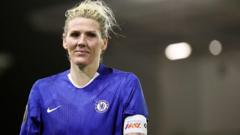
Millie Bright's Career Comes to an Abrupt End
In a heartfelt announcement that has reverberated through the world of women's football, Chelsea captain Millie Bright has retired from the sport with immediate effect. The 32-year-old defender, who has been a stalwart for both club and country, revealed that a long-standing injury has made it impossible for her to continue playing. This decision marks the end of an era for one of England's most respected players, leaving fans and teammates to reflect on her remarkable contributions.
Bright's career began in the lower leagues of English football, where her tenacity and defensive prowess quickly caught the eye of scouts. She joined Chelsea in 2014, a move that propelled her into the upper echelons of the Women's Super League (WSL). Over the years, she became synonymous with Chelsea's success, captaining the team to multiple WSL titles and leading them to the UEFA Women's Champions League final in 2021. Her leadership on the pitch was characterized by her no-nonsense style, aerial dominance, and ability to organize the defense under pressure.
Achievements with Chelsea and England
During her time at Chelsea, Bright amassed an impressive array of trophies, including five WSL championships and three FA Cups. She was instrumental in Chelsea's dominant run in the mid-2020s, helping the team maintain their status as one of Europe's top clubs. Off the field, Bright was a vocal advocate for women's football, pushing for better facilities, equal pay, and increased visibility for the sport. Her efforts helped elevate the profile of the WSL, drawing more fans and sponsorships to the league.
On the international stage, Bright earned 82 caps for England, playing a key role in the Lionesses' successes. She was a central figure in England's run to the UEFA Women's Euro 2022 final, where they clinched the title, and contributed significantly to their campaigns in the 2023 and 2027 FIFA Women's World Cups. In 2026, as England prepared for upcoming qualifiers, Bright's retirement leaves a noticeable gap in the squad, particularly in defense, where her experience and composure were invaluable. Her partnership with defenders like Leah Williamson and Alex Greenwood formed the backbone of England's backline, making her absence a significant blow.
- WSL titles: 5 (2015, 2017, 2020, 2023, 2025)
- FA Cup wins: 3 (2018, 2020, 2024)
- England caps: 82, with 8 goals
- Key international tournaments: Euro 2022 winner, World Cup semi-finalist in 2023
The Injury That Led to Retirement
Bright's retirement stems from a chronic knee injury that she first sustained in 2024 during a Champions League match. Despite undergoing multiple surgeries and extensive rehabilitation, the injury continued to hinder her performance and caused ongoing pain. In her statement, Bright expressed gratitude for her career but acknowledged that continuing to play would risk further damage to her health. "After careful consideration and consultation with medical experts, I've decided it's time to step away," she said. This announcement, made public through official channels, has prompted an outpouring of support from the football community, highlighting her impact both on and off the pitch.
The decision comes at a pivotal moment for Chelsea, who are in the midst of a competitive 2026 season. With Bright as captain, the team had been eyeing another domestic double, but her absence will require strategic adjustments. Manager Emma Hayes, who has been with Chelsea for over a decade, praised Bright as "a true leader and inspiration." Hayes noted that the club would honor Bright's legacy by continuing to build on the foundations she helped establish.
Implications for Chelsea and Women's Football in 2026
Bright's retirement has broader implications for Chelsea, who must now rebuild their defense without one of their most reliable players. The club is likely to scout for replacements in the transfer market, potentially targeting young talents from the WSL or international prospects. This development could accelerate the rise of emerging stars within Chelsea's squad, such as 22-year-old defender Jessie Fleming, who may step into a more prominent role. For England's national team, the timing is challenging, as they gear up for the 2027 World Cup qualifiers. Head coach Sarina Wiegman will need to adapt tactics to compensate for Bright's experience, possibly relying on a rotation of younger players to fill the void.
In the context of women's football in 2026, Bright's exit underscores the physical toll of the professional game, especially for defenders who face high-intensity matches week after week. It also highlights the need for improved injury prevention and support systems in the sport. As women's football continues to grow, with record attendances and broadcast deals, players like Bright have been at the forefront of this evolution. Her advocacy for mental health and player welfare has set a precedent, influencing policies across leagues. Fans and analysts alike are discussing how her retirement might inspire the next generation to prioritize longevity and well-being.
Overall, Millie Bright's career serves as a benchmark for excellence in women's football. Her retirement is not just the end of a personal journey but a moment for the sport to reflect on its progress and challenges. As Chelsea and England move forward, Bright's legacy will endure, reminding everyone of the passion and dedication required to reach the top.